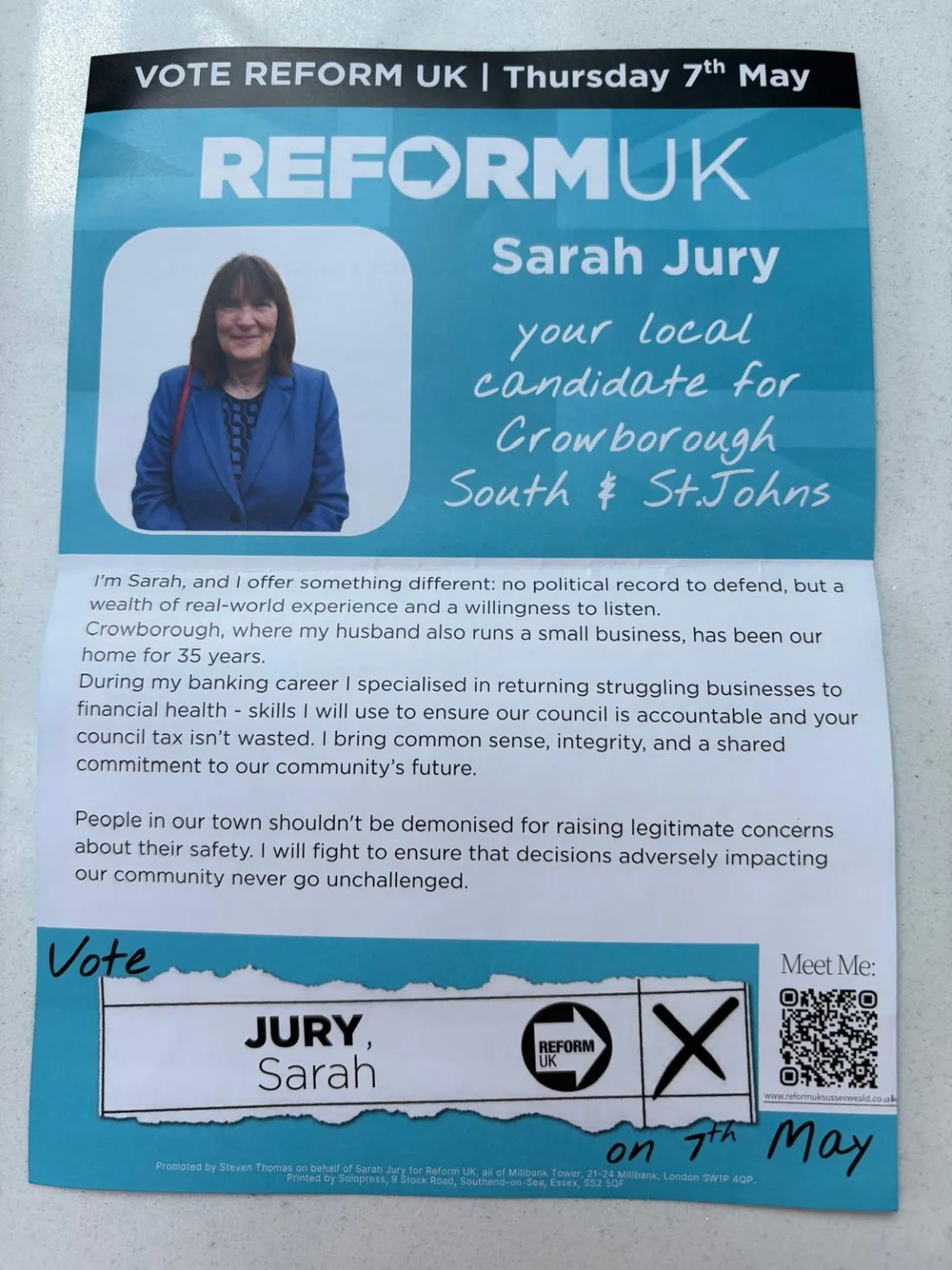
Methodology updated 2 October 2026. The dashboard is now organised around the exact wording of Sarah Jury’s May 2026 election leaflet and the publicly verifiable evidence set against each item. It replaces an earlier single 0–20 score that combined routine council participation with local activity.
Previous methodology: the score published under the earlier single-score method was 9/20, as at 7 September 2026. That method is no longer used.
What this dashboard records
It records publicly verifiable activity: published ESCC minutes and attendance records, the meeting webcasts, and local and regional press. Campaign items are assessed only against publicly verifiable evidence. Where no activity has been identified, the dashboard says “No qualifying public action identified to date”. That is a statement about the public record. The absence of identified public evidence does not show that no private work, casework or representation took place.
Entries are based on publicly verifiable sources. Where activity is reported by the press but is not independently documented by ESCC, the source is identified.
There is no overall score, grade, percentage or verdict.
Campaign wording
The election leaflet is the primary source for campaign wording, reproduced exactly from the photographed leaflet. Its front is Sarah Jury’s personal candidate statement, promoted on her behalf. Its reverse is headed “REFORM UK – Our Plan for East Sussex” and contains eight forward-looking Reform UK commitments and one statement of fact.
Sarah Jury’s personal pledges are distinguished from the Reform UK commitments. The reverse-side commitments are Reform UK’s, printed on the leaflet promoted on her behalf; they are not treated as her personal pledges. A statement of fact, such as “Balance the Books”, is checked for accuracy and is not given a delivery assessment, because it is not a promise.
Where wording is aspirational rather than measurable, it is shown but not treated as a measurable commitment.
How evidence is matched
Evidence counts against a commitment only where its subject matter relates to that commitment. General attendance and general committee contribution are not delivery against a campaign commitment. Council roles are shown as context and carry no weight.
Sarah Jury’s own activity is kept separate from the activity of the Cabinet, the administration and other councillors. That wider activity is shown as council / administration activity and is not attributed to her without evidence of her involvement.
Activity is distinguished from outcome. A public statement is not a formal council action, and neither is an outcome. An outcome is recorded only where the evidence establishes one.
The latest position of each commitment is derived from the evidence: “Activity identified; outcome not established”, “Outcome identified”, or “No qualifying public action identified to date”.
Geographical scope
The scope of each commitment follows its actual wording: Crowborough-wide, county-wide, or her own division. Where the wording is not specific, the page says so.
Activity within her county division, Crowborough South & St Johns, is distinguished from activity elsewhere in Crowborough. The location of an item is checked against electoral-boundary data before it is attributed. Activity that lies outside her division, or whose exact location has not been established sufficiently to attribute it to the division, is shown as wider Crowborough activity, is not counted as South & St Johns activity, is relevant only to commitments that are explicitly town-wide, and is never presented as constituency representation.
Council participation
Participation is supporting context. It counts attendance and contributions at meetings of which she is a member and which have taken place. Apologies are recorded separately from absence, as ESCC records them. A contribution is counted where published minutes attribute remarks to her or where a manual review of the ESCC meeting webcast identified one; the minutes generally do not attribute individual remarks to members. Chairing a meeting is counted as a contribution to it.
Substitute attendance at a committee she is not a member of is shown separately and is not counted. Attendance at meetings of which she is not a member is not counted.
Sources
East Sussex County Council published minutes and attendance records (democracy.eastsussex.gov.uk), meeting webcasts, and local and regional press, including Sussex Express, The Argus and Crowborough News. All entries are sourced; where information is absent, that absence is noted, not assumed.